

In footwear midsole manufacturing, supercritical fluid (SCF) injection uses nitrogen (N₂) as a physical blowing agent to create microcellular foam structures within thermoplastic materials. There is no single “best” material for SCF injection. Material selection depends on nitrogen solubility, diffusion behavior, melt strength, and crystallization characteristics during foaming.
Unlike traditional EVA autoclave or chemical foaming processes, SCF injection is a fully thermoplastic process. It does not involve chemical blowing agents or crosslinking. Foam formation is driven entirely by dissolved nitrogen and controlled pressure reduction.
In practice, TPU and TPEE are the most established materials in SCF injection today. aTPU represents an evolution of TPU toward lower weight performance. PEBA offers the highest performance potential but is still developing in injection-based systems. SEBS is used for softer, comfort-driven applications, while EVA is increasingly viable but still evolving.
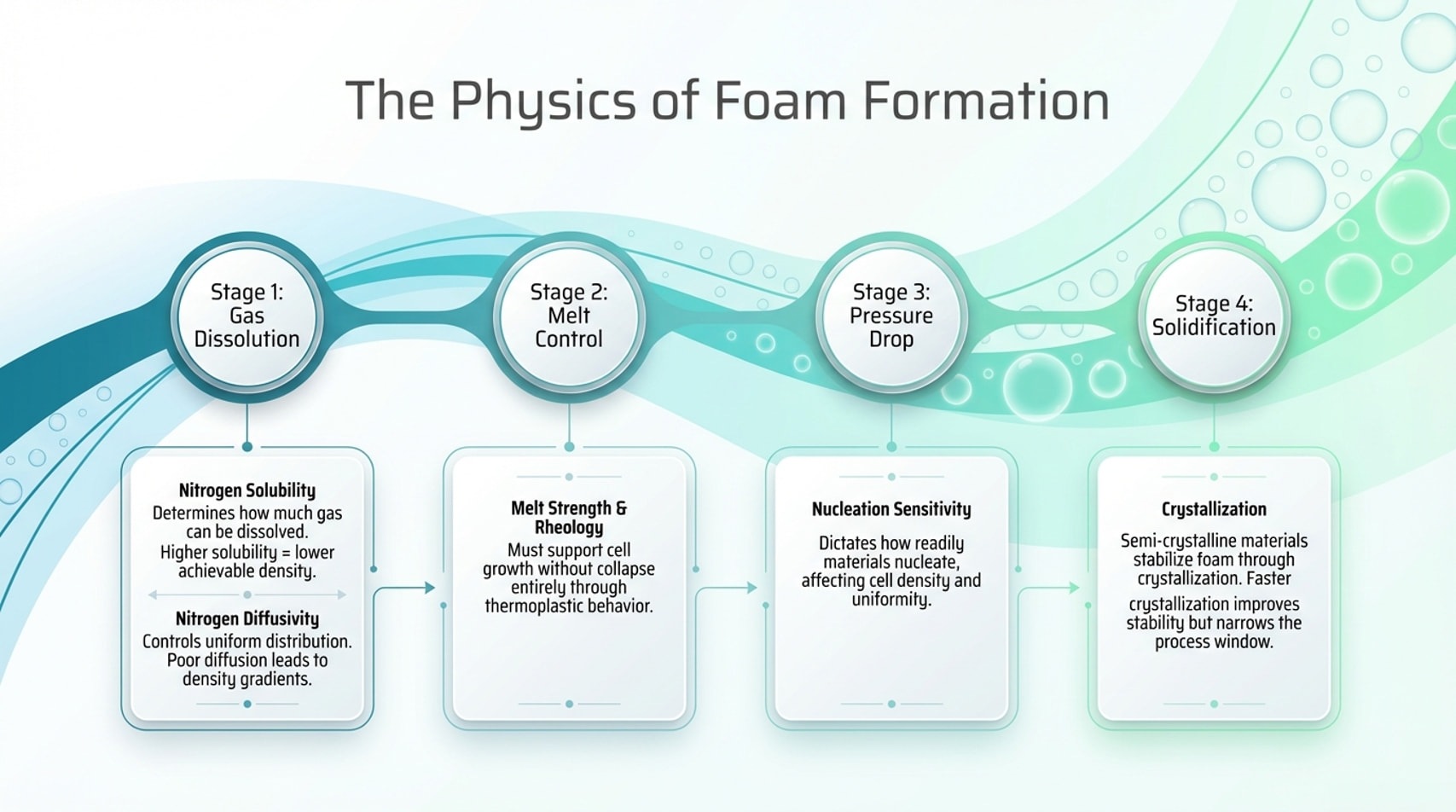
Key Material Requirements for SCF Injection (N₂-Based Systems)
Nitrogen Solubility
Nitrogen solubility determines how much gas can be dissolved into the polymer. Higher solubility enables greater expansion potential and lower achievable density.
Nitrogen Diffusivity
Diffusion rate controls how uniformly nitrogen distributes throughout the melt. Poor diffusion leads to inconsistent nucleation and density gradients.
Melt Strength and Rheology
Melt strength must be generated entirely through thermoplastic behavior, as no crosslinking occurs during SCF injection. Materials must support cell growth during pressure drop without collapse.
Crystallization and Solidification Behavior
Semi-crystalline materials can stabilize foam structure through crystallization. Faster crystallization can improve stability but may narrow the process window.
Nucleation Sensitivity
Materials differ in how readily they nucleate during pressure reduction. This affects cell density, uniformity, and performance.
Material-by-Material Comparison for SCF Injection
TPU vs aTPU (Thermoplastic Polyurethane vs Aliphatic TPU)
Standard TPU is one of the most established materials in SCF injection. It offers strong durability, good rebound, and a relatively stable processing window. However, conventional TPU systems are typically limited by density compared to newer superfoam materials.
aTPU represents an evolution of TPU materials that enables lower density while maintaining the durability and rebound TPU is known for. This makes aTPU more suitable for performance-oriented footwear where weight reduction is critical.
From a processing standpoint, TPU and aTPU behave similarly in SCF injection. The primary difference is performance outcome: TPU is a stable, durable workhorse material, while aTPU enables lighter weight and improved performance within the same framework.
Compared to TPEE, TPU offers a more forgiving process window but lower peak rebound. Compared to PEBA, TPU and aTPU are more durable and easier to process, but cannot achieve the same level of lightweight performance.
Density Range (current):
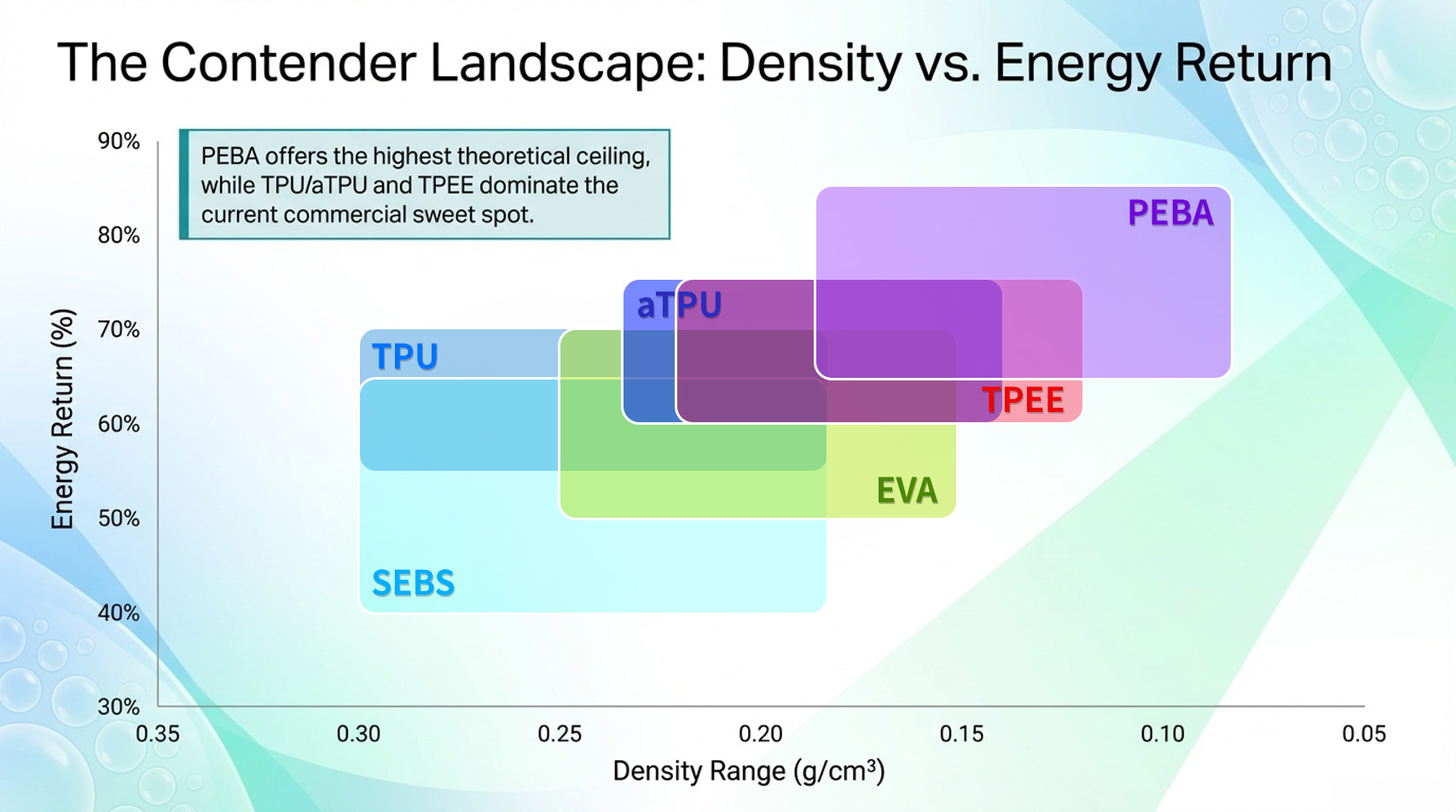
- TPU: ~0.18–0.30 g/cm³
- aTPU: ~0.14–0.24 g/cm³
Energy Return (typical):
- TPU: ~55–70%
- aTPU: ~60–75%
Strengths:
- Stable and mature SCF processing
- High durability and fatigue resistance
- Consistent foam structure
Limitations:
- Higher density compared to PEBA and advanced systems
- Moderate energy return relative to top-tier materials
TPEE (Thermoplastic Polyester Elastomer)
TPEE is a semi-crystalline block copolymer composed of polyester hard segments and polyether soft segments. In SCF injection, its crystallization behavior plays a key role in stabilizing the foam structure after nucleation.
Compared to TPU, TPEE generally provides higher rebound and allows for lower density structures while maintaining structural integrity. It is often positioned as a step up in performance relative to TPU, particularly in running applications.
Compared to PEBA, TPEE typically offers better durability and a slightly more robust processing window, but does not reach the same extremes in energy return or weight reduction. It represents a balanced material between TPU and PEBA.
However, TPEE is more sensitive to thermal conditions than TPU. Its faster crystallization can narrow the processing window, requiring tighter control.
Density Range (current):
~0.12–0.22 g/cm³
Energy Return (typical):
~60–75%
Strengths:
- High resilience and rebound
- Good balance of performance and durability
- Lower density potential than TPU
Limitations:
- Narrower processing window
- Sensitive to temperature and cooling
PEBA (Polyether Block Amide)
PEBA is a high-performance block copolymer composed of polyamide (nylon) hard segments and polyether soft segments. This structure enables excellent elasticity, high rebound, and the potential for very low-density foam structures.
In SCF injection, PEBA shows strong technical potential due to its gas solubility and elastic recovery, allowing for higher expansion ratios compared to TPU or TPEE.
However, PEBA is not yet widely commercialized in SCF injection systems. Most PEBA foams used in footwear today are produced using autoclave or bead expansion processes. SCF injection of PEBA remains an area of active development.
Compared to TPU and TPEE, PEBA offers the highest performance potential but is more sensitive to processing and less mature in injection manufacturing.
PEBA is a family of materials. One well-known commercial example is Pebax, with additional suppliers including Evonik and UBE Corporation.
Density Range (current):
~0.08–0.18 g/cm³
Energy Return (typical):
~65–85%
Strengths:
- Highest energy return potential
- Lowest density capability
- Lightweight performance
Limitations:
- Higher cost
- Less mature in SCF injection
- Sensitive processing
SEBS (Styrenic Block Copolymer)
SEBS is an amorphous thermoplastic elastomer that does not crystallize. Foam stabilization relies entirely on melt strength and cooling.
This results in a softer, more compliant foam suited for comfort applications.
Compared to TPU, SEBS is softer and easier to process but less durable. Compared to TPEE and PEBA, it provides lower energy return and limited performance capability.
Density Range (current):
~0.18–0.30 g/cm³
Energy Return (typical):
~40–60%
Strengths:
- Soft feel
- Stable processing
- Comfort-focused
Limitations:
- Lower structural performance
- Limited low-density capability
EVA (Ethylene Vinyl Acetate)
In SCF injection, EVA is processed as a thermoplastic material without crosslinking. Foam formation relies entirely on melt strength and rheological behavior.
Compared to TPU and TPEE, EVA has lower inherent melt strength, making it more sensitive to process conditions. This can lead to challenges in maintaining uniform cell structure.
However, EVA offers advantages in cost, availability, and familiarity. Compared to SEBS, it provides better structural performance but requires tighter control.
EVA is increasingly viable as formulations improve, but remains less mature than TPU and TPEE in SCF injection.
Density Range (current SCF):
~0.15–0.25 g/cm³
Energy Return (typical):
~50–70%
Strengths:
- Cost-effective
- Widely available
Limitations:
- Lower melt strength
- Narrow process window
- Developing technology
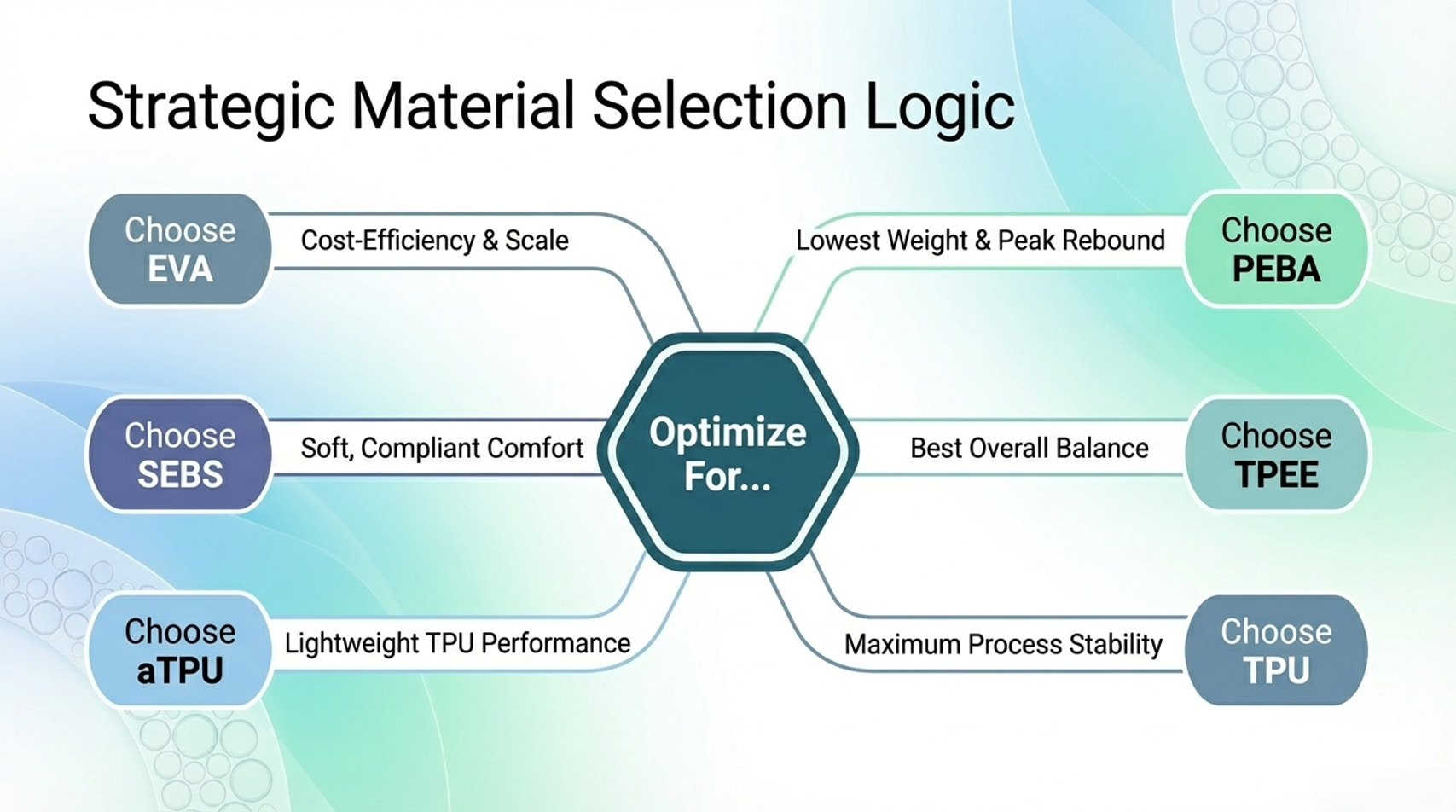
Practical Material Selection Logic
- Lowest weight → PEBA
- Best balance → TPEE
- Most stable → TPU
- Lightweight TPU → aTPU
- Soft comfort → SEBS
- Cost-driven → EVA
Future Outlook for SCF Injection Materials
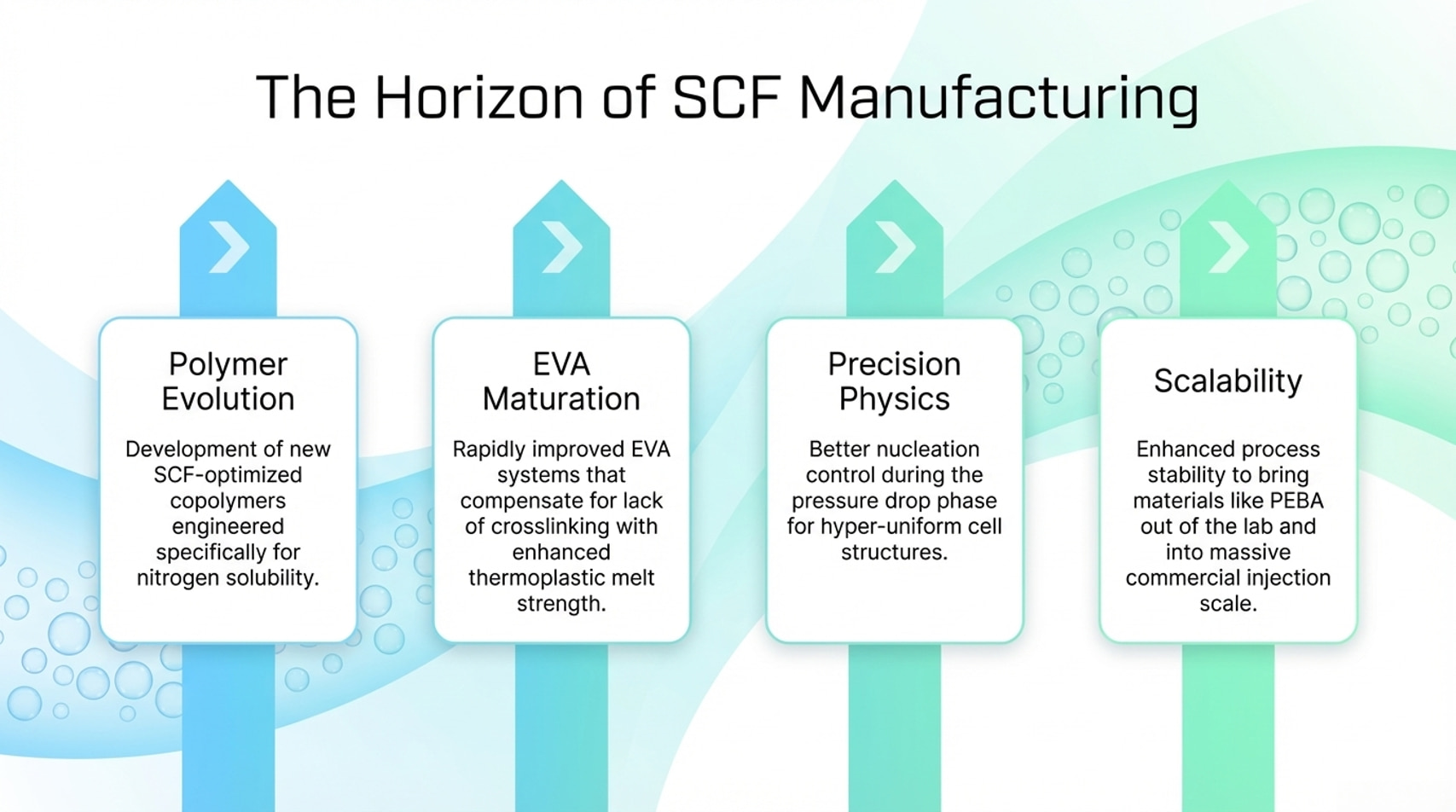
Material development is focused on:
- SCF-optimized copolymers
- Improved EVA systems
- Better nucleation control
- Enhanced process stability
Q&A
Q: Why isn’t PEBA used everywhere yet if it offers the best performance?
A: While PEBA provides the highest energy return and lowest density potential, it is more expensive and not yet widely commercialized in SCF injection systems, making scalability and process stability current limitations.
Q: What makes TPU the most widely used material in SCF injection today?
A: TPU offers the best combination of process stability, durability, and consistent foam formation, making it the most reliable material for large-scale production.
Q: How does aTPU improve upon traditional TPU in footwear applications?
A: aTPU enables lower-density foam structures while maintaining the durability and rebound of TPU, making it more suitable for lightweight performance footwear.
Q: Why is TPEE often considered a balanced option between TPU and PEBA?
A: TPEE provides higher rebound and lower density than TPU while maintaining better durability and processing stability than PEBA, making it a strong middle-ground material.
Q: If EVA is so widely used in footwear, why is it still developing in SCF injection?
A: In SCF injection, EVA must rely on thermoplastic melt strength without crosslinking, which makes foam stability more difficult to control compared to traditional EVA processes.
Q: What role does nitrogen play in SCF injection, and why is it used?
A: Nitrogen acts as a physical blowing agent that dissolves into the polymer under pressure and forms a microcellular structure when pressure is reduced during molding.
Q: Does SCF injection involve chemical blowing agents or crosslinking reactions?
A: No. SCF injection is a fully thermoplastic process that relies on dissolved nitrogen and controlled pressure changes, without chemical blowing agents or crosslinking.
Q: What are the key trade-offs when selecting a material for SCF injection?
A: Material selection involves balancing density, energy return, durability, process stability, and cost, as no single material optimizes all of these factors.
Note
Density and energy return values are representative ranges based on current commercial SCF injection systems. Actual performance depends on formulation, processing conditions, and test methodology. These ranges are expected to evolve as materials and processes continue to develop.