
Introduction
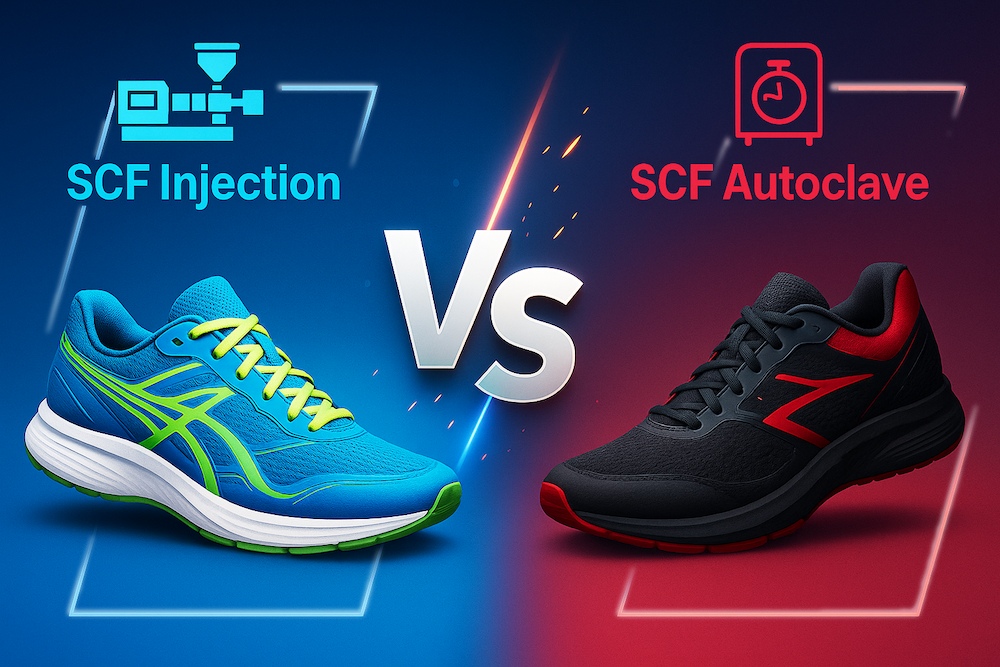
Footwear brands are continually pushing for innovations that enhance performance, reduce environmental impact, and increase production efficiency. Two advanced technologies leading this transformation are Supercritical Fluid (SCF) Injection and the SCF Autoclave Process.
Both leverage the unique properties of supercritical fluids, typically carbon dioxide (CO₂) or nitrogen (N₂) under high pressure and temperature, to transform polymers like EVA, TPU, and others into high-performance foams. While the end result often looks similar (lightweight, responsive midsoles or cushioning components), the processes behind SCF injection and autoclave are fundamentally different.
This article outlines the individual pros and cons of each method, compares them side by side, and concludes by showing why Tienkang is a trusted leader in SCF injection technology for footwear manufacturing.
1.Pros and Cons of the SCF Injection Process
How SCF Injection Works
Unlike conventional molding, SCF injection involves mixing a polymer melt with supercritical gas (usually nitrogen) before injection. The polymer and SCF form a single-phase solution inside a temperature controlled, pressurized chamber. Once injected into a mold, the sudden and controlled depressurization triggers rapid foaming of the polymer as the SCF gas expands and separates—creating a microcellular foam directly in the mold.
This method is ideal for making lightweight and highly responsive midsoles with fine-tuned mechanical properties.
Pros of SCF Injection
- Uniform Microcellular Foam: Produces consistent cell structure with superior cushioning.
- Lightweight and Strong: Ideal for midsoles that require both responsiveness and durability.
- Customizable Foam Properties: Fine control over pressure, SCF concentration, and cooling enables tuning of foam density and rebound.
- Efficient and Scalable: High throughput and short cycle times suitable for commercial production.
- Eco-Friendly: Eliminates need for chemical blowing agents and reduces VOCs.
Cons of SCF Injection
- High Initial Investment: Requires precision machinery to handle high pressures and accurate dosing of SCF gas.
- Technical Complexity: Achieving consistent results depends on precise control of temperature, pressure, and injection speed.
- Material Limitations: Not all polymers are compatible with SCF processes and formulations may need adjustment.

2.Pros and Cons of SCF Autoclave Process
How the SCF Autoclave Process Works
In contrast to injection, the SCF autoclave process saturates solid or pre-formed polymer blanks in a pressurized chamber filled with supercritical gas. The material absorbs the gas over time under controlled temperature and pressure. Once removed from the chamber and exposed to lower pressure or heat, the gas rapidly expands within the polymer, creating a foam.This technique is especially useful for experimental applications or when uniformity and deep saturation are required.
Pros of SCF Autoclave Process
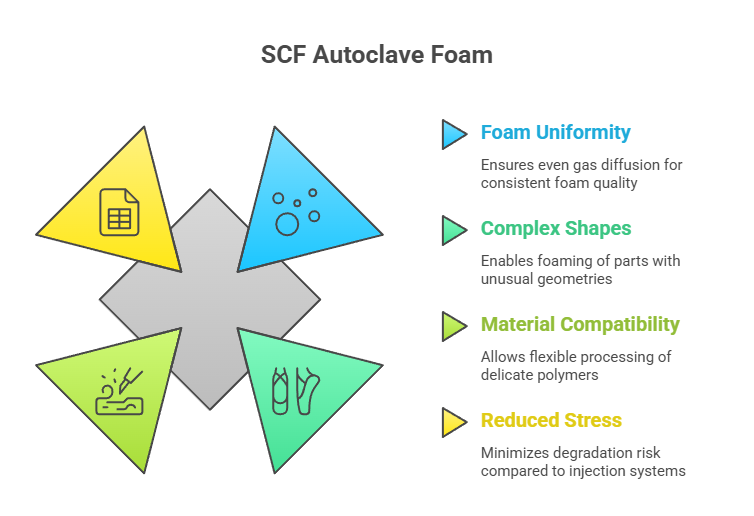
- Excellent Foam Uniformity: Gas diffuses deeply and evenly throughout the material.
- Ideal for Complex Shapes or High-End Products: Enables foaming of parts with unusual geometries or detailed surface textures.
- Material Compatibility: Allows more flexible processing of sensitive or delicate polymers.
- No Shear or Injection Stress: Reduces risk of degradation compared to injection systems.
Cons of SCF Autoclave Process
- Longer Cycle Times: Saturation and expansion steps can be time-intensive.
- Lower Throughput: Best suited for batch processing or prototyping.
- Energy Intensive: Large autoclaves require significant power to maintain temperature and pressure.
- Higher Capital & Space Requirements: Autoclave systems are large and complex, requiring more floor space and safety infrastructure.
3.SCF Injection vs. SCF Autoclave: Side-by-Side Comparison
|
Category |
SCF Injection |
SCF Autoclave |
|
Foam Formation |
Occurs during mold injection via controlled |
Occurs post-saturation via pressure drop or |
|
Production Speed |
High-speed, inline production |
Slower, batch-based processing |
|
Foam Uniformity |
Very good with proper control |
Excellent due to deep saturation |
|
Design Flexibility |
Moderate¡Vdependent on mold and injection |
High¡Vcan foam complex geometries |
|
Material Flexibility |
Requires compatible polymer/SCF mix |
Broader material compatibility |
|
Capital Cost |
High (but scalable) |
Higher, especially for large chambers |
|
Best For |
Mass production of midsoles, cushioning foams |
R&D, specialty foams, or high-end |
Summary:
- Choose SCF injection for high-volume production of athletic footwear components with consistent mechanical properties.
- Choose SCF autoclave for small-batch or specialized applications requiring extreme uniformity or materials that need gentle processing.
4.Why Tienkang is the Ideal Partner for SCF Injection Technology
Tienkang is a global leader in equipment manufacturing for the footwear industry, specializing in high-performance systems for EVA and foam molding, including SCF injection solutions. With a reputation built on innovation, reliability, and integration expertise, Tienkang offers powerful advantages!
Why Partner with Tienkang?
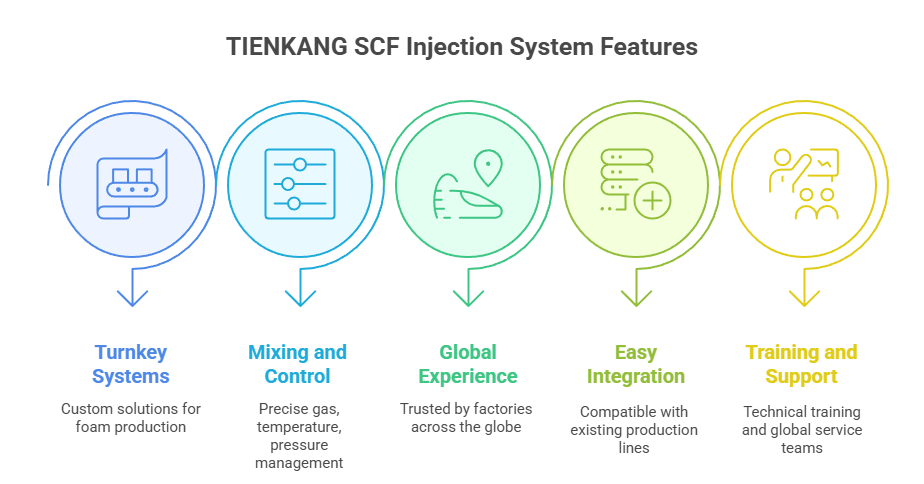
- 🏆 Turnkey SCF Injection Systems: Custom-built solutions tailored for lightweight foam midsole and outsole production.
- ⚙️ Advanced Mixing and Control Units: Ensures precision gas dosing, temperature, and pressure management.
- 🌍 Proven Global Experience: Trusted by footwear factories worldwide, from sportswear giants to innovative startups.
- 🧩 Easy Integration: Compatible with existing production lines for seamless upgrades or scaling.
- 🛠️ Training and Support: Includes technical training, maintenance, and global service teams to ensure long-term success.
Tienkang’s focus on sustainability, process control, and scalable automation makes it the ideal partner for companies adopting SCF injection technology.
Conclusion
Both SCF injection and SCF autoclave processes are reshaping the future of footwear manufacturing by enabling cleaner, lighter, and more functional foam materials. Each has a unique role.
- SCF injection delivers high-speed, high-precision foam manufacturing for performance and lifestyle footwear.
- SCF autoclave offers unrivaled material control and flexibility for experimental, niche, or premium products.
For footwear brands ready to adopt SCF injection at scale, Tienkang delivers the technology, expertise, and global support to lead the way.
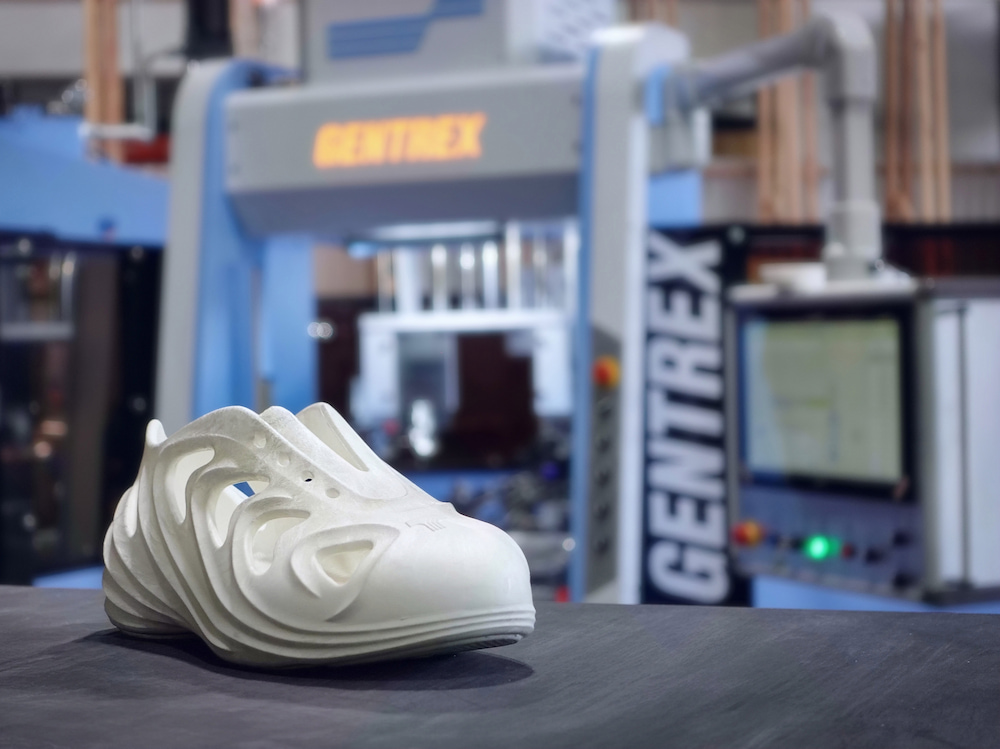
More information: Supercritical fluid injection -GENTREX