
GENTREX | SCF INJECTION TECHNICAL ARTICLE
A Technical Guide to Factory Regrind Reuse, Performance Risks, Reuse Rate, and Production Validation
GENTREX SCF Injection Recycling Assessment for Footwear Foam Manufacturing
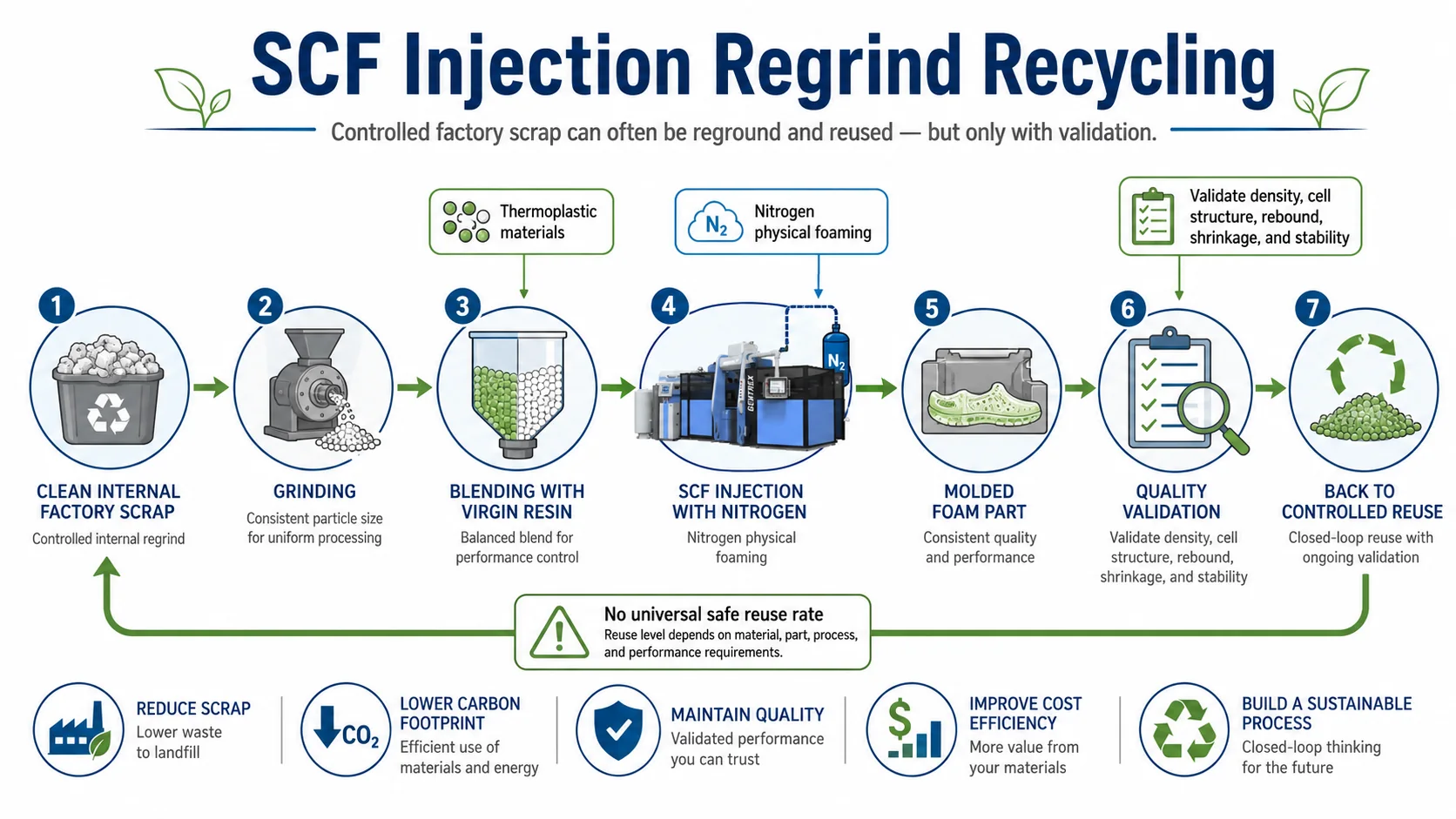
Figure 1. Overview of SCF injection regrind recycling: controlled internal factory scrap can often be reground and reused, but only through validated process control.
Quick Answer
| Can SCF injection foam scrap be reused? Yes. Clean internal factory scrap from thermoplastic SCF physical foaming injection can often be ground and reused as regrind. However, there is no universal safe reuse percentage. The allowable level must be validated for the material, part design, density target, process condition, cosmetic standard, mechanical performance, and production stability. This article addresses controlled internal factory regrind—not post-consumer footwear recycling. |
Key Takeaways
- SCF injection can offer a recycling advantage when thermoplastic polymers and nitrogen physical foaming are used.
- Factory regrind should be treated as a controlled engineering input, not as waste casually added back into production.
- Regrind can change viscosity, nitrogen dissolution, cell structure, density, shrinkage, rebound, compression set, appearance, bonding, color, odor, and process stability.
- The correct reuse rate is not a universal number; it is a validated process condition.
- Post-consumer footwear recycling is a different challenge because material identity, contamination, additives, coatings, adhesives, and processing history may be unknown.
1. What Does Recycling Mean in SCF Physical Foaming Injection?
In this article, recycling means the controlled reuse of clean internal factory scrap generated during SCF physical foaming injection. The scrap is ground into particles, managed by material identity and history, blended with virgin resin where appropriate, and reprocessed under validated conditions.
SCF physical foaming injection can use thermoplastic polymers and nitrogen as a physical blowing agent. Nitrogen is dissolved into the polymer melt under pressure, and cells form when pressure decreases during injection into the mold. The foaming mechanism does not require chemical blowing-agent decomposition, and the foaming step does not require chemical crosslinking.
| Important scope distinction This assessment focuses on controlled internal factory regrind. It does not claim that used footwear, mixed footwear components, or uncontrolled post-consumer material can be directly returned to the same SCF injection process. |
2. Why Can SCF Injection Offer a Recycling Advantage Over Crosslinked EVA?
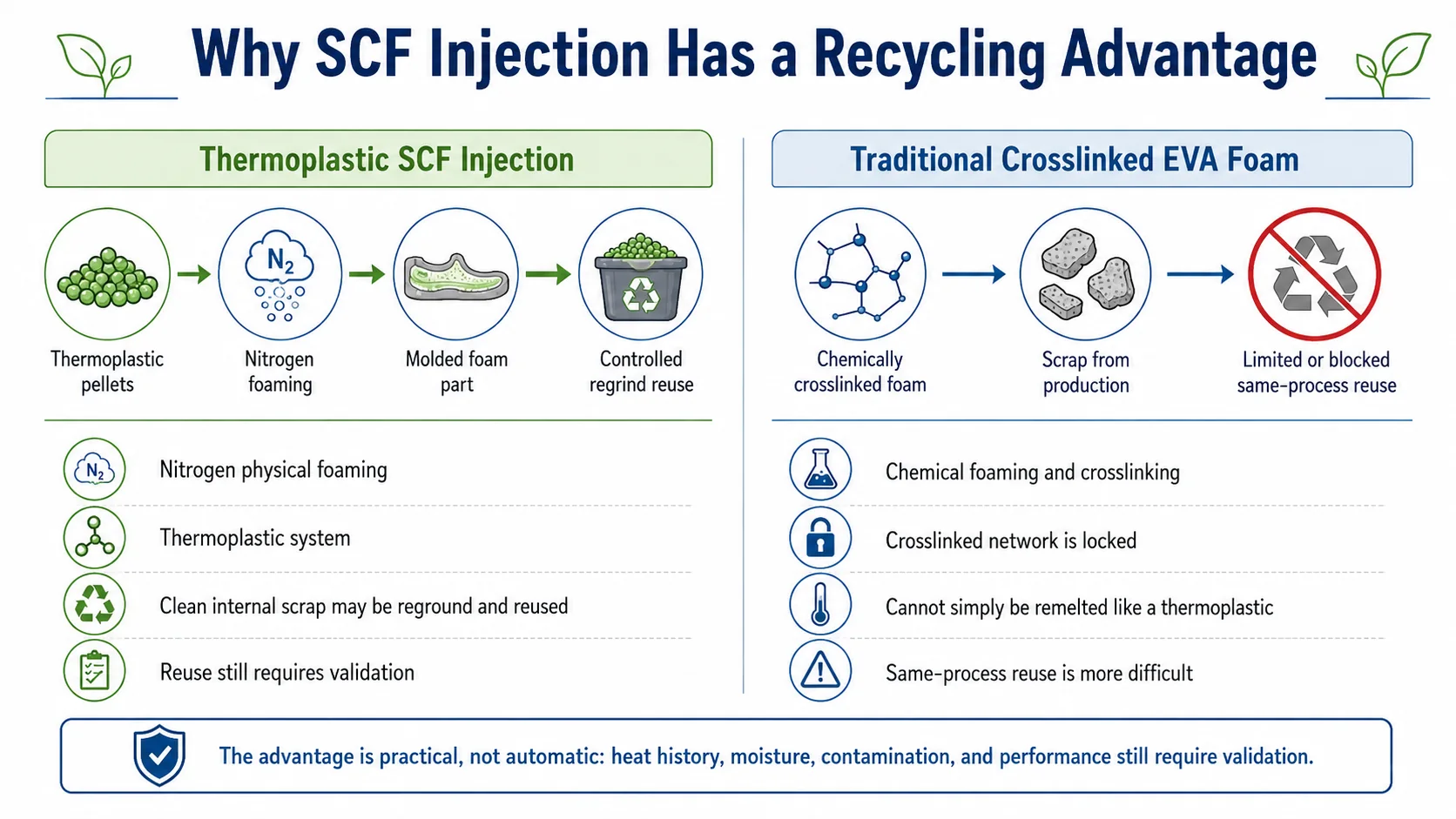
Figure 2. Comparison of thermoplastic SCF injection and traditional crosslinked EVA foam from a recycling and same-process reuse perspective.
When the polymer system is thermoplastic, clean SCF process scrap can potentially be reground, blended back with virgin material, and reprocessed. This can reduce internal waste, improve material utilization, and support lower-scrap manufacturing.
The key word is “potentially.” Thermoplastic materials are remeltable, but they are not immune to degradation. Heat history, shear history, residence time, moisture, oxidation, contamination, particle size, and prior foaming history can all change the behavior of the material during the next molding cycle.
| Assessment Area | Thermoplastic SCF Injection | Traditional Crosslinked EVA Foam |
|---|---|---|
| Foaming mechanism | Nitrogen physical foaming | Chemical foaming and crosslinking are commonly involved |
| Polymer condition after molding | Thermoplastic system may remain remeltable | Chemically crosslinked network is locked |
| Internal clean scrap reuse | Potentially suitable for grinding, blending, and reprocessing after validation | Cannot simply be remelted and reprocessed like a thermoplastic |
| Main control concern | Material history, degradation, moisture, contamination, feeding, and performance validation | Crosslinked structure and mixed or treated scrap limit same-process reuse |
| Practical sustainability value | Pathway to reduce controlled factory scrap | Same-process material recovery is more difficult |
3. What Counts as Acceptable Factory Regrind?
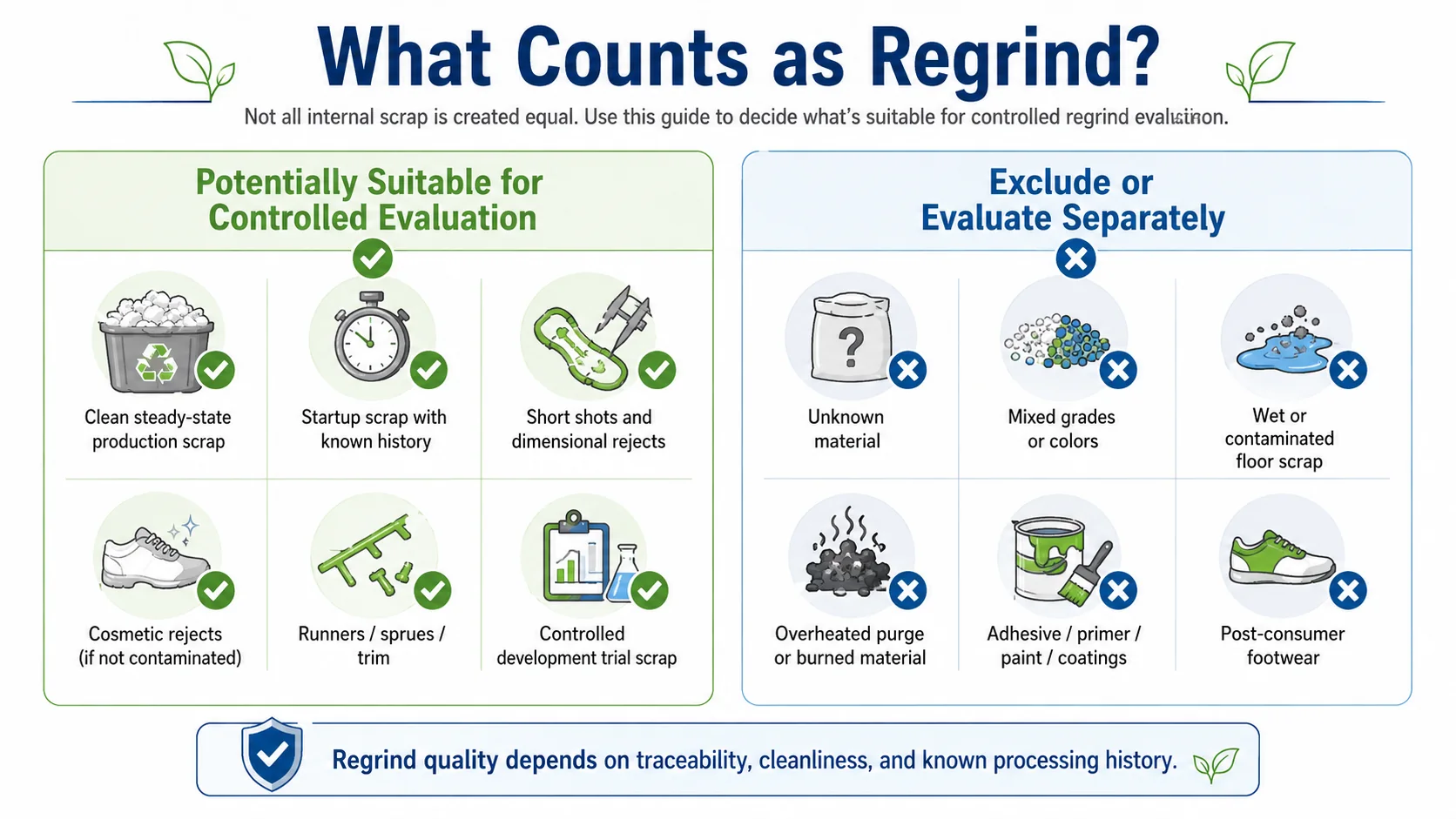
Figure 3. Internal scrap categories that may be suitable for controlled regrind evaluation versus materials that should be excluded or separately assessed.
Factory regrind is generated inside the manufacturing process, where material family, grade, color, source, processing history, and contamination risk can be controlled. Common sources may include startup parts, short shots, runners or sprues where applicable, trimmed scrap, cosmetic rejects, dimensional rejects, nonconforming molded parts, and development trial scrap with known material history.
Not all internal scrap is equal. Startup scrap may have a different thermal history from steady-state production scrap. Purge material may have excessive residence time or partial degradation. Cosmetic rejects may be acceptable when the defect is unrelated to contamination or material damage. Floor scrap may be unacceptable when cleanliness cannot be verified.
| Potentially Suitable for Controlled Evaluation | Exclude or Evaluate Separately |
|---|---|
| • Clean steady-state production scrap | • Unknown material, mixed grades, or mixed colors |
| • Startup scrap with documented material history | • Wet, oily, dirty, or contaminated floor scrap |
| • Short shots and dimensional rejects | • Overheated purge or burned material |
| • Cosmetic rejects unrelated to contamination or degradation | • Scrap containing adhesive, primer, paint, or coatings |
| • Runners, sprues, and trim waste where applicable | • Material with excessive dust or fines |
| • Controlled development trial scrap | • Post-consumer footwear or unknown processing history |
4. Why Can Regrind Change SCF Foam Behavior?
Regrind has already experienced at least one processing cycle. Compared with virgin resin, it may carry additional heat history, shear history, residence time, oxidation exposure, moisture pickup, grinding damage, and handling variation.
These changes are especially important in SCF injection foam because the polymer must dissolve nitrogen, flow consistently, nucleate cells, expand, stabilize cell walls, cool, and demold without excessive shrinkage or collapse. A change in viscosity, melt strength, moisture level, or degradation state can alter the entire foam structure.
| Regrind Variable | Possible Process Effect | Possible Product Risk |
|---|---|---|
| Heat and shear history | Viscosity drift or degradation | Density variation, weak cell walls, lower mechanical performance |
| Moisture | Hydrolysis and melt instability | Bubbles, odor, surface defects, viscosity loss, property loss |
| Inconsistent particle size | Uneven feeding, melting, and blending | Weight variation, color variation, unstable expansion |
| Excessive fines and dust | Feeding fluctuation, burning, contamination | Roughness, surface defects, odor, cosmetic inconsistency |
| Different bulk density from virgin pellets | Metering and blend-ratio fluctuation | Cavity-to-cavity variation and density drift |
| Unknown or multiple reprocessing histories | Unpredictable melt behavior | Shrinkage, compression set, rebound, and durability risk |
5. What Performance Problems Can Poorly Controlled Regrind Cause?
The main risk is not that the material is recycled. The risk is that the regrind may no longer behave exactly like the original virgin resin.
- Unstable melt viscosity and inconsistent nitrogen dissolution
- Larger, less uniform, or unstable cell structure
- Density drift and cavity-to-cavity variation
- Shrinkage, dimensional instability, or foam collapse
- Surface striations, roughness, burning, or cosmetic defects
- Color variation and odor
- Lower tensile strength, tear strength, or bonding consistency
- Poorer rebound or compression set
- Startup instability and reduced production repeatability
For footwear midsoles and cushioning parts, visual acceptance alone is not sufficient. A part may look acceptable but still have poor cell structure, weak compression recovery, unstable dimensions, or reduced long-term cushioning performance. Likewise, a part that meets density targets may still fail appearance, color, odor, bonding, or customer requirements.
6. What Regrind Percentage Is Safe for SCF Injection Foam?
| Direct answer There is no universal safe regrind percentage for SCF injection foam. The correct reuse rate is a validated process condition, not a fixed industry number. |
The allowable reuse level depends on the polymer family, grade, color, density target, part thickness, cosmetic standard, mechanical requirements, drying capability, grinder quality, blending accuracy, machine residence time, mold design, and the number of prior heat histories.
A reuse level that works for one SEBS comfort component may not work for a high-rebound TPEE midsole. A black part may tolerate visual variation that would be unacceptable in white or translucent material. A low-density performance foam may be more sensitive to viscosity drift than a higher-density lifestyle component.
| The better engineering question What regrind level can this material and process tolerate while still meeting density, appearance, mechanical performance, dimensional stability, bonding, odor, and production repeatability requirements? |
7. How Should a Factory Control Regrind Before Production?
1. Segregate by identity: Separate material family, grade, color, and source. Do not mix materials unless the blend has been specifically validated.
2. Separate by scrap source: Keep steady-state scrap, startup scrap, trial scrap, purge, and rejected finished parts in separate streams.
3. Control grinding quality: Use consistent particle size and minimize dust and fines that can affect feeding, melting, appearance, and contamination risk.
4. Prevent contamination: Protect material from floor dirt, oil, water, release agents, adhesive, primer, paint, coatings, and mixed polymers.
5. Dry hygroscopic materials: Use controlled drying appropriate for TPU, aTPU, TPEE, PEBA, and other moisture-sensitive polymers.
6. Meter the blend accurately: Control and document the regrind concentration. Blend-ratio fluctuation can create product drift even when machine settings remain unchanged.
7. Track heat history: Identify single-pass regrind and material that has undergone multiple processing cycles. Unknown-history scrap should not be treated as fresh controlled regrind.
8. How Should Regrind Use Be Validated?
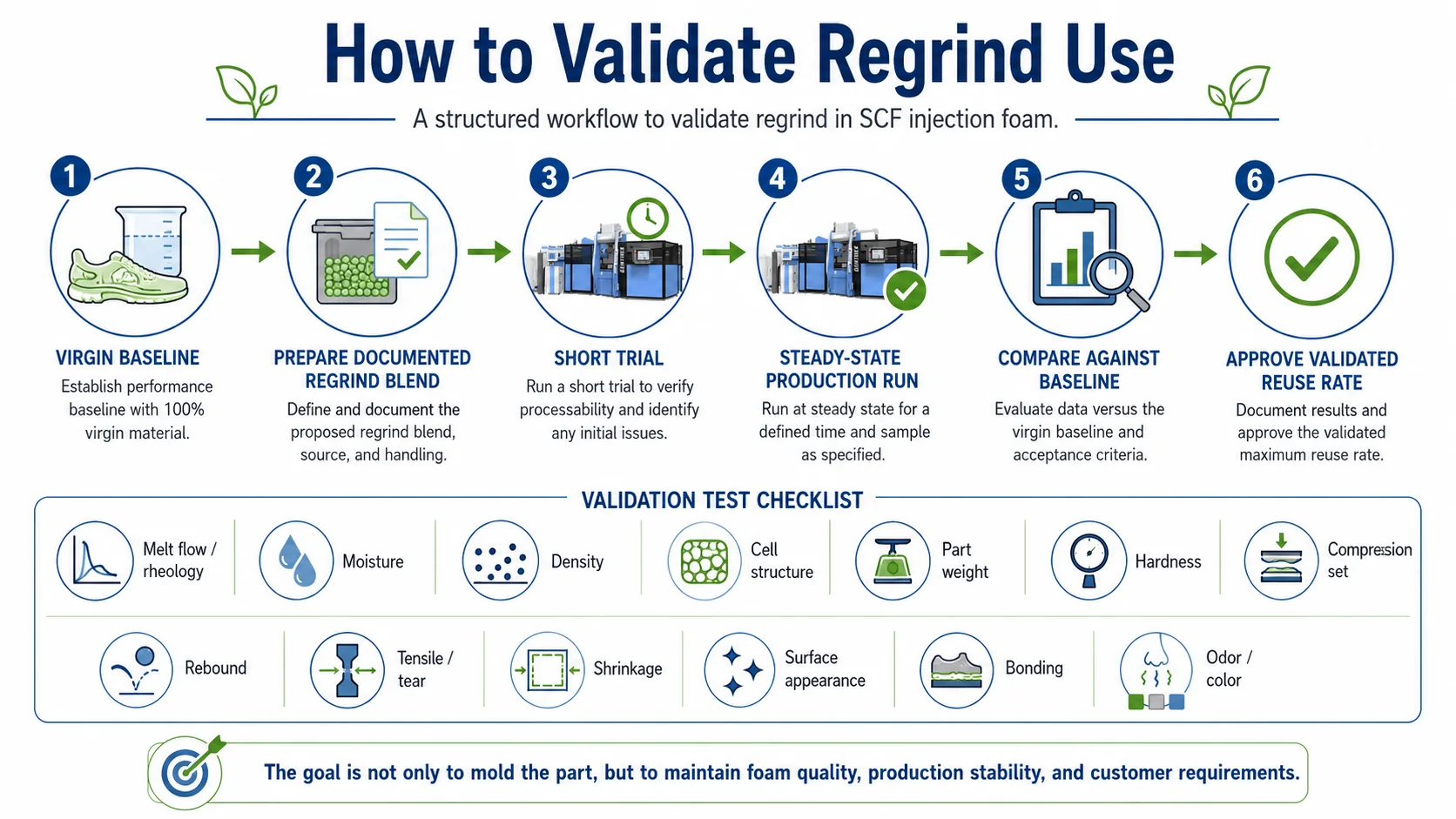
Figure 4. Recommended validation workflow and test checklist for approving a regrind reuse rate in SCF injection foam production.
Validation should begin with a virgin-material baseline. The factory should first understand normal part weight, density, cell structure, hardness, compression set, rebound, shrinkage, dimensional stability, surface appearance, bonding, color, odor, and process stability using virgin resin.
1. Establish the virgin baseline and normal production variation.
2. Prepare a documented regrind blend with known material source, particle size, drying condition, and heat history.
3. Compare the proposed blend against the virgin baseline in short trials.
4. Run longer production validation after the system reaches steady-state conditions.
5. Evaluate startup and steady-state production separately when the process is sensitive during stabilization.
6. Approve the reuse rate only when material, part, production, and customer requirements are consistently met.
| Validation Area | Why It Matters | Suggested Check |
|---|---|---|
| Melt flow or rheology | Detects viscosity drift or degradation | MFI, rheology, and process-pressure trend |
| Moisture | Prevents hydrolysis and instability | Moisture analyzer and documented drying control |
| Cell structure | Confirms foam uniformity | Cross-section microscopy |
| Density | Confirms expansion consistency | Mass/volume or Archimedes method |
| Part weight | Tracks dosing and process stability | Shot-weight and part-weight records |
| Hardness | Checks cushioning consistency | Defined hardness test and multi-point comparison |
| Compression set | Confirms cushioning recovery | Compression set testing |
| Rebound | Confirms energy return | Ball rebound or mechanical testing |
| Tensile and tear | Confirms mechanical integrity | Tensile and split-tear testing |
| Shrinkage | Confirms dimensional stability | Aged dimensional measurement |
| Surface appearance | Detects striations, roughness, burning, and color drift | Visual standard and golden samples |
| Bonding | Confirms assembly compatibility | Peel testing |
| Odor and color | Confirms consumer and customer acceptability | Visual and odor checks |
| Heat aging, where needed | Checks long-term retention | Defined aging protocol and post-aging comparison |
The goal is not simply to prove that regrind can be molded. The goal is to prove that it can be used repeatedly while maintaining foam quality, production stability, and customer requirements.
9. How Do Regrind Risks Differ by Material?
| Material | Main Regrind Concerns | Validation Focus |
|---|---|---|
| Thermoplastic EVA | Crystallization behavior, shrinkage, and density stability | Surface appearance and dimensional stability; do not confuse with traditional crosslinked EVA scrap |
| TPU / aTPU | Moisture pickup, hydrolysis, melt stability, odor, and property retention | Drying control, mechanical retention, appearance, and process stability |
| TPEE | Crystallization, hard-segment structure, and post-foaming stabilization | Compression set, rebound, shrinkage, and dimensional stability |
| PEBA | High sensitivity in performance applications, moisture, and melt stability | Shrinkage, rebound, mechanical performance, and tight process control |
| SEBS | Softness, oil content, odor, feeding consistency, and surface quality | Density stability, appearance, odor, and formulation consistency |
10. What Can Internal Regrind Not Solve?
Internal regrind can improve material efficiency, but it does not automatically create a circular footwear system. It does not solve post-consumer footwear recycling, mixed-material separation, contamination, adhesive removal, coating removal, or unlimited polymer reuse.
Repeated reprocessing can still degrade polymers. High-performance footwear foam still requires mechanical and production validation. A recycled-content claim should not be made simply because internal scrap is being reused. The sustainability benefit is real, but it should be described accurately.
| Accurate sustainability statement SCF injection creates a practical pathway for reducing controlled factory scrap. It is not a guarantee that every foam part can be recycled indefinitely or that post-consumer footwear can be returned directly to the same process. |
11. Frequently Asked Questions
Can SCF injection foam scrap be recycled?
Clean internal factory scrap from thermoplastic SCF injection foam can often be ground and reused as regrind, but the reuse level must be validated for the specific material, part, and production process.
Is SCF injection more recyclable than crosslinked EVA?
In many cases, yes. SCF injection can use thermoplastic materials and nitrogen physical foaming, while crosslinked EVA contains a chemically locked network that is much harder to remelt and reprocess.
Why focus on factory regrind instead of post-consumer recycling?
Factory regrind has known material identity and controlled history. Post-consumer footwear may contain dirt, sweat, adhesives, coatings, mixed materials, unknown additives, odor, and contamination. These conditions create different safety, quality, regulatory, and performance risks.
What regrind percentage is safe?
There is no universal safe percentage. The allowable reuse rate must be validated through material testing, molded-part testing, production trials, and customer requirements.
Can 100% regrind be used?
It should not be assumed. Full regrind use may be possible only in specific validated cases, but it can also increase the risk of viscosity drift, degradation, moisture problems, color variation, odor, and performance loss.
Does regrind affect foam density?
It can. Regrind may affect melt viscosity, nitrogen dissolution, nucleation, cell growth, and stabilization, all of which can influence foam density and density uniformity.
Does regrind affect rebound or compression set?
It can. Reprocessing may change molecular weight, phase structure, crystallization behavior, melt strength, and final cell morphology. These changes can affect rebound, compression set, and long-term cushioning performance.
Does nitrogen foaming make recycling harder?
Nitrogen itself does not create the same recycling challenge as chemical crosslinking or chemical blowing-agent residues. The main concerns are polymer degradation, moisture, contamination, material history, and performance validation.
Conclusion: Regrind Is an Engineering Input, Not Waste
SCF physical foaming injection offers a meaningful recycling advantage because it can use thermoplastic materials and nitrogen physical foaming. Clean internal factory scrap can potentially be reused as regrind, reducing waste and improving material efficiency.
However, regrind should be treated as a controlled engineering input, not as waste material added back into production. The safe reuse level must be validated through material-handling controls, process trials, molded-part testing, cosmetic inspection, and performance evaluation.
When managed correctly, internal regrind can support more efficient and responsible SCF injection foam production. When managed poorly, it can introduce instability, defects, and performance risk. The difference is not whether regrind is used, but whether it is controlled, validated, and understood.