

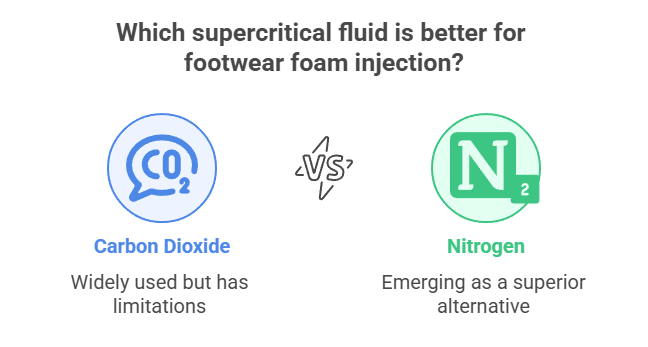
As footwear brands race to create lighter, more responsive, and environmentally conscious products, the manufacturing techniques behind midsoles and cushioning systems are evolving rapidly. One such innovation is the use of supercritical fluids (SCFs) in physical foaming processes. While carbon dioxide (CO₂) has long been used in this space, nitrogen (N₂) is emerging as a superior alternative for foam injection in footwear applications. This article explores why.
Supercritical Fluids in Footwear Manufacturing
In SCF foaming, a gas is injected into a polymer melt under specific temperature and pressure conditions. Upon depressurization, the fluid expands, creating a cellular structure that reduces weight and improves cushioning. Unlike chemical blowing agents, SCFs like CO₂ and N₂ are physical agents, making them cleaner and more controllable. The choice between CO₂ and N₂, however, significantly impacts foam quality, process reliability, and product performance.
Why Nitrogen Is Gaining Traction
1.Superior Cell Structure and Uniformity
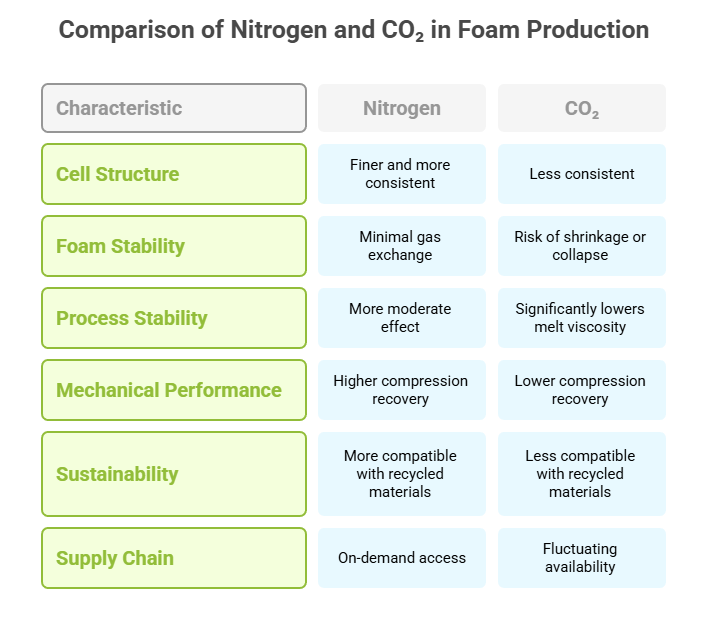
Nitrogen tends to produce finer and more consistent foam cells. Because it has lower solubility in polymers than CO₂, it diffuses more gradually during pressure release. This slower nucleation helps create a dense, uniform microcellular structure, which translates to more consistent underfoot cushioning and improved long-term durability.
2.Foam Stability After Processing
A critical benefit of using N₂ is its compatibility with ambient air. Since nitrogen comprises about 78% of the atmosphere, foam created with N₂ experiences minimal gas exchange with its environment after molding. This reduces the risk of shrinkage or collapse that can occur with CO₂-foamed products, where the gas often diffuses out rapidly and causes post-processing deformation. The result: better shape retention and dimensional stability in midsoles and insoles.
3.Thermal and Process Stability
Unlike CO₂, which significantly lowers melt viscosity, N₂ has a more moderate effect, offering better control over the foaming process. This leads to more consistent mold filling and better support for intricate designs. For manufacturers, it means greater repeatability, fewer defects, and a smoother production workflow.
4.Improved Mechanical Performance
Footwear demands materials that maintain resilience under repeated loading. N₂-foamed materials typically deliver higher compression recovery and more stable energy return due to their finer cell structures. These properties are especially beneficial in running shoes, performance trainers, and high-end athletic footwear.
5.Sustainability and Recyclability
Nitrogen’s inert nature makes it more compatible with recycled materials and reduces risk of undesirable chemical reactions during processing. Additionally, on-site nitrogen generation is widely feasible and reduces reliance on supply chains tied to fossil fuel byproducts—an advantage for brands pursuing greener operations.
6.Supply Chain Stability
Whereas CO₂ often comes from industrial sources with fluctuating availability, nitrogen can be extracted from the air using standard generation systems. This enables footwear manufacturers to have on-demand access, avoid supply interruptions, and reduce long-term costs.
Final Thoughts
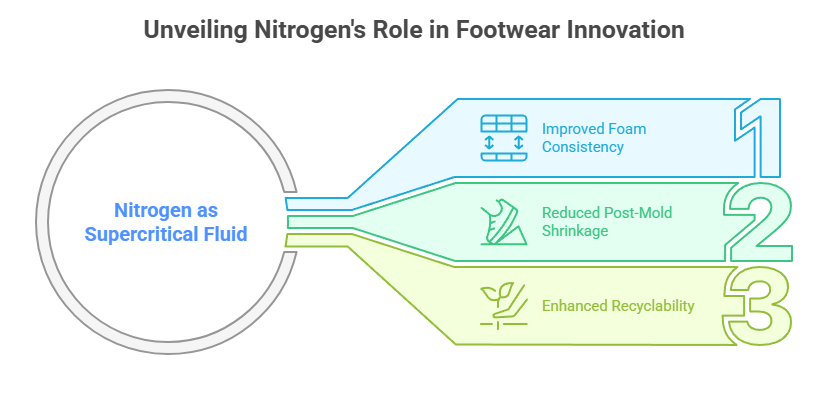
As performance standards rise and sustainability goals become more ambitious, material innovation is no longer optional—it’s strategic. Nitrogen, with its unique physical and environmental advantages, is poised to become the supercritical fluid of choice in footwear manufacturing. Whether it’s about achieving better foam consistency, reducing post-mold shrinkage, or enabling more recyclable products, N₂ offers the precision and reliability today’s footwear industry demands.
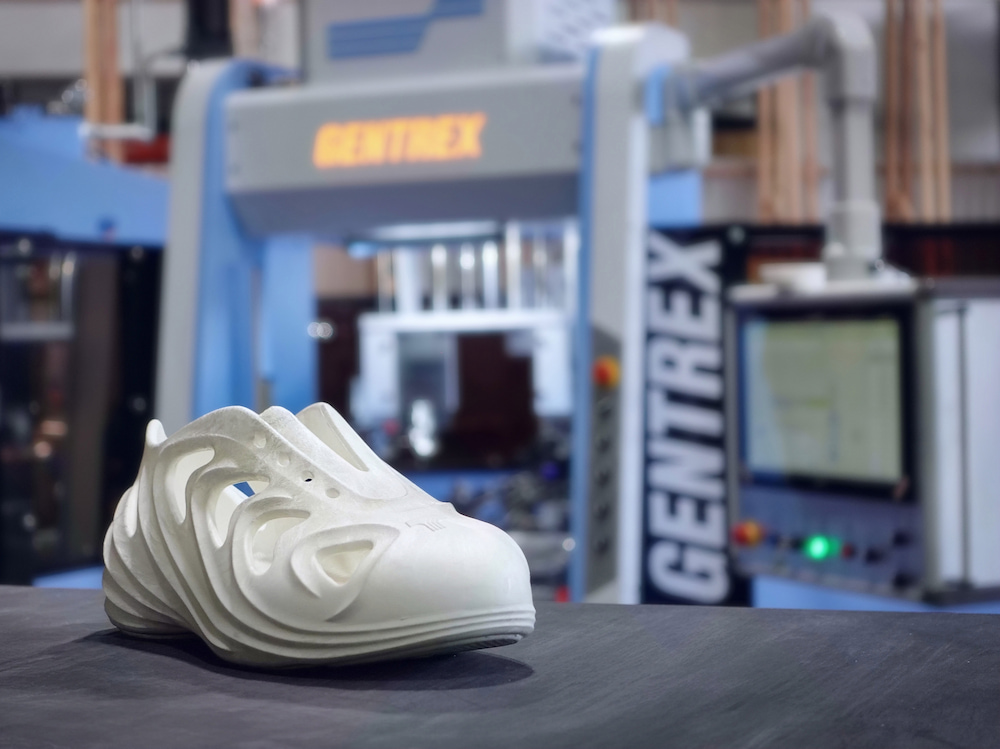
More information: Supercritical fluid injection -GENTREX