
Supercritical fluids are materials that exist at a temperature and pressure above its critical point where there is no distinct state of matter as we formally know. Meaning that its not a liquid, not a gas and not a solid. A supercritical fluid is sometimes referred to as gas-liquid phase hybrid and employs properties of both phases. The supercritical region can be found above the critical point which is at the end of the two-phase line between the gas and liquid regions.
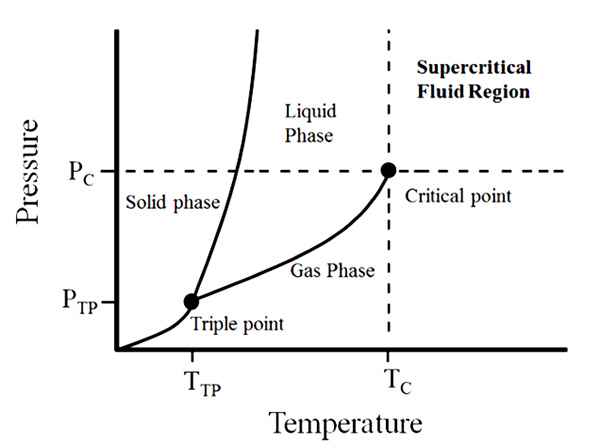 A generic phase diagram showing the 3 phases of matter and the supercritical region
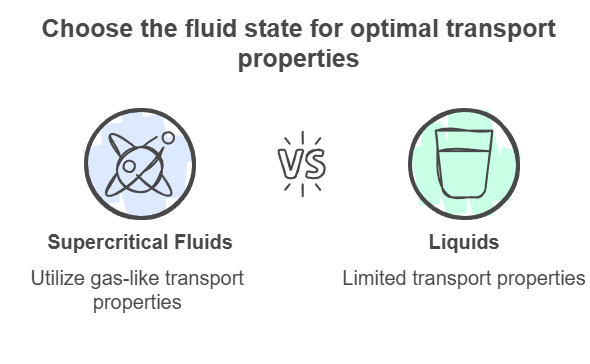
Supercritical fluids behave like gases in that they have favorable transport properties. These include low viscosity, which allows for fast mass transport within a volume, and zero surface tension. This means that a supercritical fluid can fill a volume completely and all at once rather than a liquid which fills a volume from the bottom up.
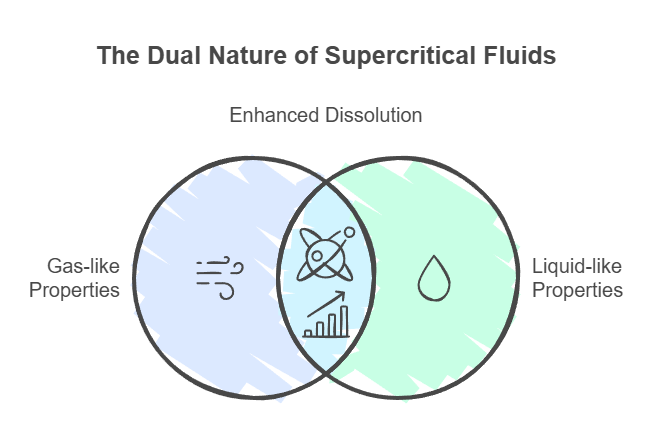
Supercritical fluids also behave like liquids in that they have a tunable density which allows for much higher dissolution of materials than would be possible in air. Think of this like dissolving sugar in water vs dissolving sugar in air. You can dissolve a lot of sugar in water, and essentially none in air.
So now that you understand what a supercritical fluid is, why do you care?
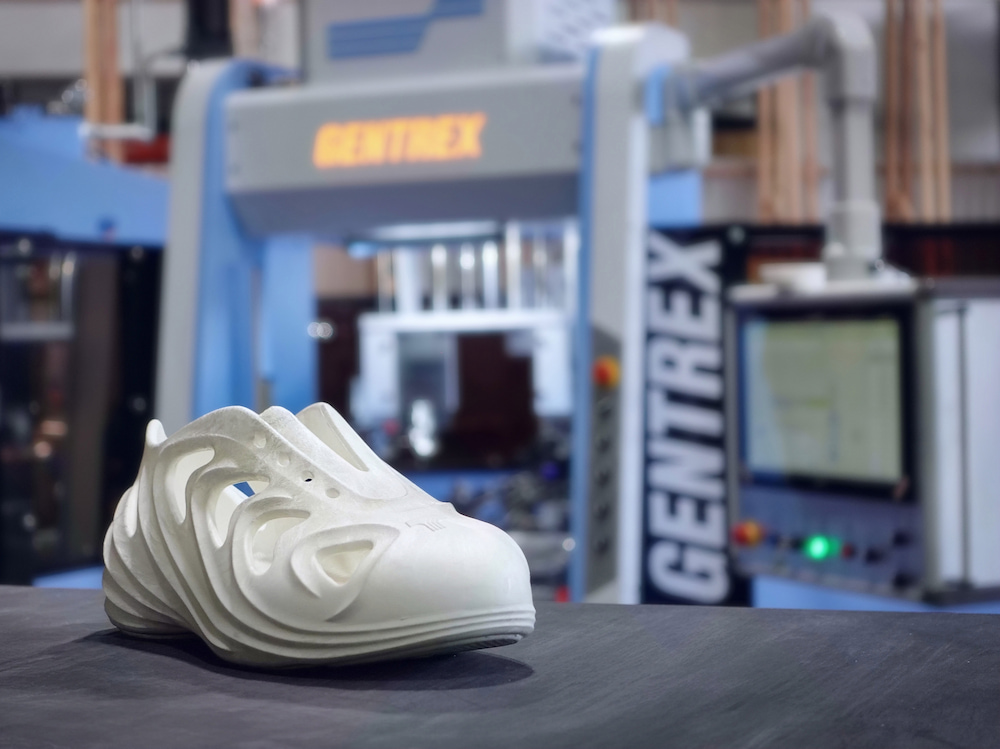
In the typical footwear manufacturing process, to produce a midsole foam, you melt polymers and additives, like blowing agents and crosslinking agents, and inject them into a mold. In the mold, by controlling temperature, you decompose your blowing agent which evolves gas, causing the polymer to foam. You also allow the polymer to crosslink, creating a stable foam matrix. With supercritical fluids, however, you can dissolve your polymer and additives, into a supercritical nitrogen or carbon dioxide. By leveraging the benefits of the supercritical state, you can achieve a high concentration of polymer that is uniformly mixed with the nitrogen or carbon dioxide. After injecting into a mold, a quick depressurization and temperature drop causes the polymer to fall out of the supercritical nitrogen or carbon dioxide, leaving in its place a perfectly formed foam that does not require the use of a chemical blowing agent. Given that zero surface tension exists in the supercritical phase, density tuning is possible, which allows for control of the polymer matrix. This specific trait is key to dialing in desirable properties for the footwear industry.

In this way, you can create a “physically blown” high performance foam that does not use chemical blowing agents or chemical crosslinking agents. Because of the tunable nature of this process, you can achieve high performance foams that are “greener” and more sustainable and fully recyclable as compared to traditional footwear manufacturing processes.