

Deep within the Earth’s crust, supercritical fluids (SCFs) form under immense pressure and temperature, where the distinction between liquid and gas ceases to exist. These naturally occurring fluids, such as water and carbon dioxide, transport minerals, catalyze metamorphic reactions, and deposit metals with extraordinary uniformity. They move through rock systems with both the diffusivity of gases and the solvating power of liquids, enabling efficient material transformation. Their behavior provides a valuable model for modern footwear manufacturing, where engineers now replicate similar thermodynamic conditions to achieve precision foaming and molding of advanced polymers.
In the footwear industry, SCF injection has become a transformative process for midsoles, outsoles, and cushioning systems. These methods use gases such as carbon dioxide (CO₂) or nitrogen (N₂) in a supercritical state to create fine microcellular foams within molten polymers. The resulting materials exhibit optimized density, resilience, and rebound performance without relying on chemical blowing agents or high-energy steam systems. Among these gases, nitrogen has proven to be the superior choice. Tienkang’s Gentrex™ system, designed around supercritical nitrogen injection, represents a highly controlled, environmentally responsible evolution of the physical principles seen in nature’s own supercritical systems.
Both CO₂ and N₂ can reach a supercritical state, yet their physical and chemical properties yield distinctly different results when applied to polymer foaming. Carbon dioxide has high solubility and acts as a temporary plasticizer in many polymers. This can be advantageous in textile dyeing or polymer purification, but in injection foaming, it can lead to instability, surface whitening, or inconsistent cell growth. Nitrogen behaves differently. It is inert, nonpolar, and has moderate solubility, which encourages uniform gas dispersion, consistent nucleation, and fine closed-cell structures. These characteristics produce midsoles with superior dimensional stability, rebound, and appearance. The comparison parallels natural phenomena: in geological systems, stable supercritical fluids form uniform mineral structures, while reactive ones generate irregular deposits. The same thermodynamic principle applies in engineered foams—stability leads to precision.
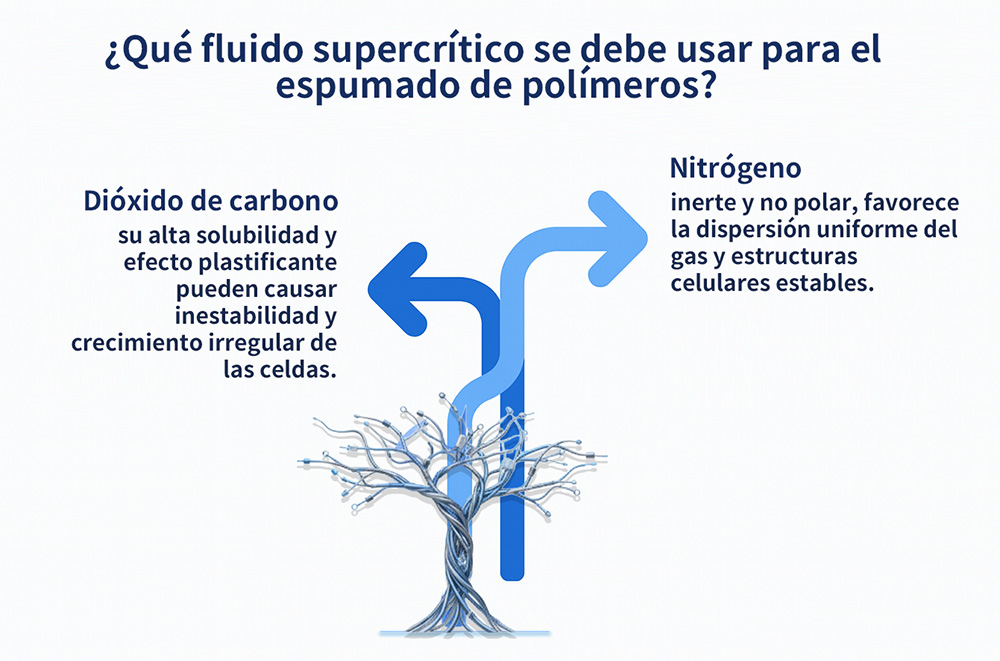
Nitrogen’s thermodynamic behavior offers further advantages in manufacturing. It maintains supercritical properties across a wide range of pressures and temperatures, providing greater flexibility and stability during injection cycles. This broad processing window allows engineers to fine-tune parameters without losing consistency or cell control. Because nitrogen is chemically inert, it does not react with polymer chains or form corrosive by-products such as carbonic acid. As a result, equipment such as Tienkang’s Gentrex™ platform experiences longer operational life and reduced maintenance requirements. The gas’s small molecular size and fast diffusion rate enhance homogeneity within the foam, minimizing cell coalescence, surface defects, and density gradients. The outcome is a lightweight, high-performance foam that meets the durability and comfort standards demanded by modern footwear brands.
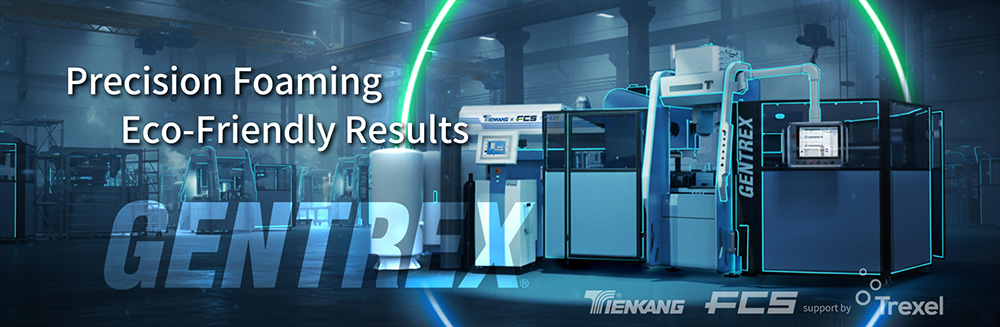
From an environmental and safety standpoint, nitrogen presents clear benefits. It is abundant, non-toxic, and requires no post-process reclamation systems. It replaces volatile chemical foaming agents with a clean, physical process that produces zero harmful emissions. This transition aligns perfectly with the industry’s move toward sustainable, circular manufacturing. When combined with recyclable thermoplastics such as EVA, TPU, or PEBA, nitrogen-based SCF injection allows for precise material control and a dramatic reduction in waste and energy consumption, all while achieving superior mechanical properties.
The connection between naturally occurring SCFs and engineered SCF injection is more than metaphorical. In Earth’s interior, mineral formation depends on the equilibrium among temperature, pressure, and composition, which governs how and where materials precipitate. Similarly, in supercritical injection foaming, these same variables control polymer cell morphology. The Gentrex™ nitrogen system applies these principles to polymer engineering, using carefully regulated pressure and temperature to sculpt foam microstructure with geological precision. This biomimetic approach—borrowing nature’s efficiency and control—enables consistent material behavior, improved rebound stability, and enhanced durability across footwear designs.
As the global footwear industry continues to pursue lower emissions, reduced chemical usage, and more energy-efficient production, the choice between CO₂ and N₂ takes on strategic importance. Nitrogen-based SCF injection represents not only a technical improvement but also a deliberate alignment with sustainability, scalability, and long-term reliability. The shift from CO₂ to N₂ reflects an evolution in manufacturing philosophy: prioritizing clean processing, robust control, and consistent performance. By studying how nature’s own supercritical systems transport and transform matter, and by translating those lessons into industrial design, Tienkang has established a new benchmark for innovation. Through Gentrex™, nitrogen becomes not just a process gas, but the cornerstone of a next-generation manufacturing platform that balances efficiency, precision, and environmental integrity.
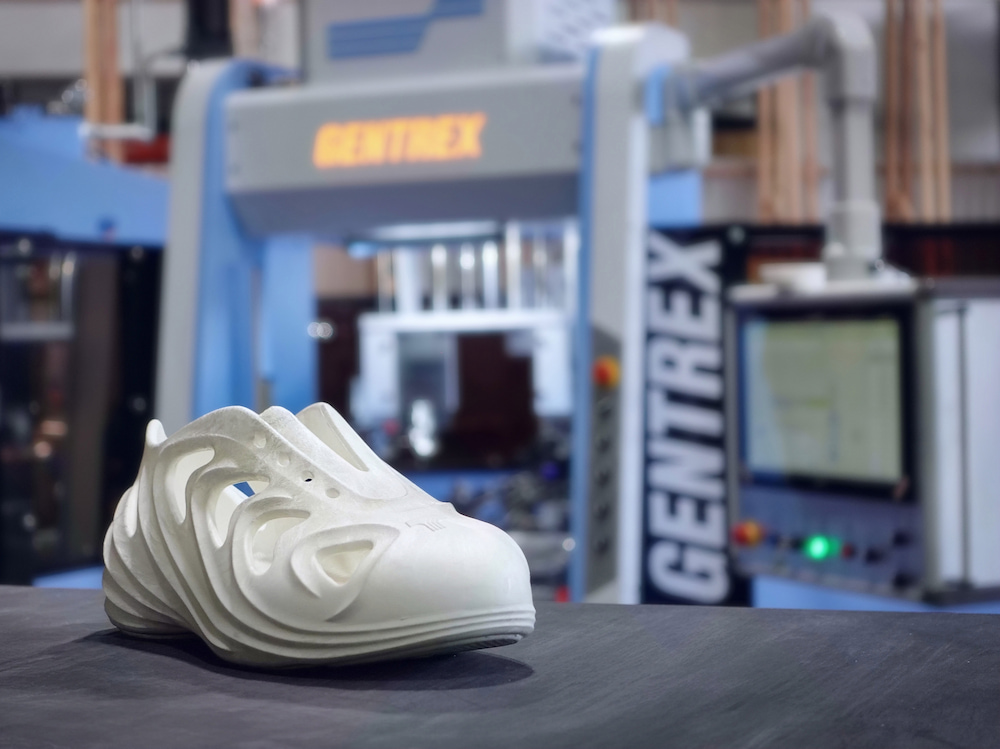
More information: Supercritical fluid injection -GENTREX