

Sustainability in footwear manufacturing requires more than substituting materials or adding recycled content. Real progress depends on re-engineering how polymers are processed and foamed. Supercritical fluid (SCF) injection has emerged as one of the most effective methods to achieve this shift. By replacing reactive chemical foaming and crosslinking agents with a controlled physical mechanism, the process enables lower emissions, improved recyclability, and higher efficiency without compromising performance. Tienkang’s GENTREX system illustrates how precisely controlled SCF injection can deliver these sustainability gains at industrial scale.
Eliminating Chemical Blowing Agents
raditional foaming of EVA, TPU, and polyolefin elastomers often relies on chemical blowing agents such as azodicarbonamide (ADCA) or p,p′-oxybis(benzenesulfonyl hydrazide) (OBSH). These compounds decompose at elevated temperatures to release gases that expand the polymer matrix. Although widely used, this chemical approach creates several challenges: volatile organic compound (VOC) emissions, residual byproducts, inconsistent cell morphology, and color instability. Managing these effects adds complexity to both production and environmental compliance.
Supercritical fluid injection replaces decomposition reactions with a clean physical process. Under supercritical conditions, inert gases dissolve into the molten polymer and expand evenly as pressure is released within the mold. This mechanism eliminates VOCs and chemical residues entirely. Because cell nucleation and growth are governed by processing parameters rather than additive chemistry, manufacturers gain finer control over foam density and uniformity. The result is a cleaner process, consistent part quality, and a measurable reduction in waste.
Nitrogen as the Preferred Supercritical Medium
Among gases suitable for SCF injection, nitrogen offers the best balance of safety, performance, and sustainability. Its inertness prevents chemical reactions with the polymer, maintaining mechanical integrity and color fidelity. Nitrogen also produces uniform microcellular structures with excellent cushioning and resilience, ideal for footwear midsoles and outsoles.
The GENTREX platform allows precise control of nitrogen saturation, temperature, and pressure, ensuring consistent foam structure across different polymer systems. Because nitrogen can be generated directly from compressed air, the process avoids reliance on externally supplied chemicals or high-pressure gas cylinders. This local generation capability lowers carbon footprint, simplifies logistics, and enhances production reliability while aligning with sustainability objectives.
Avoiding Crosslinking to Enable Chemical Recyclability
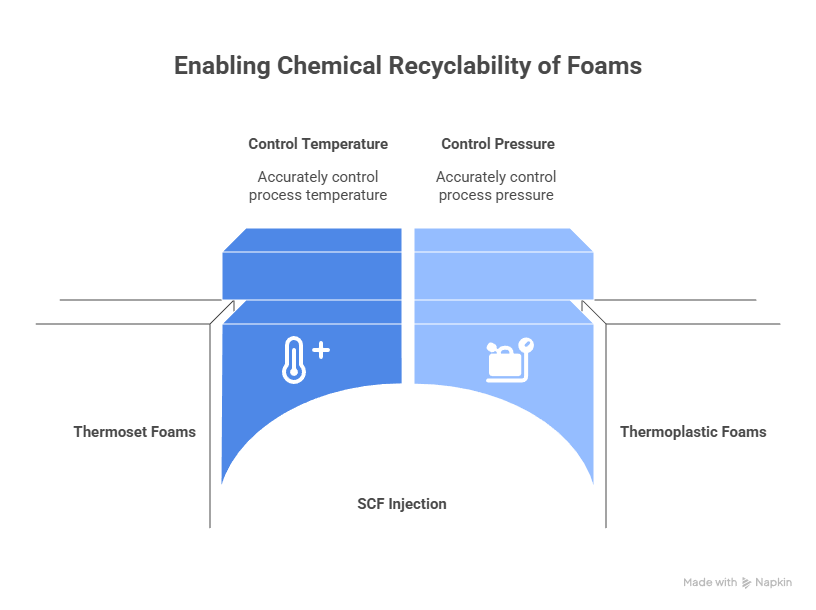
Conventional foam manufacturing frequently employs peroxides or radiation crosslinking to stabilize cell structure and prevent collapse. Although effective for dimensional control, crosslinking transforms thermoplastics into thermosets, which cannot be remelted or chemically recycled. The resulting foams can only be mechanically ground into filler, leading to property degradation and limited reuse potential.
Through accurate control of process temperature and pressure, SCF injection can produce dimensionally stable foams without crosslinking agents. The resulting materials remain thermoplastic, retaining the ability to be remelted or chemically depolymerized. This feature enables closed-loop recycling and supports circular manufacturing models in which production scrap and post-consumer materials can be reintegrated into the value stream without quality loss.
Energy and Resource Efficiency
In addition to reducing chemical inputs, SCF injection enhances process efficiency and lowers energy consumption. The dissolved gas temporarily reduces melt viscosity, allowing faster mold filling under lower injection pressures. This shortens cycle times and reduces equipment wear, yielding lower energy demand per part. Because foaming occurs in-mold, the process eliminates secondary pre-expansion and curing stages common to chemical and autoclave systems, further minimizing energy use and factory footprint.
Material utilization also improves. The direct in-mold expansion minimizes trimming waste, and when non-crosslinked polymers are used, scrap material can be reprocessed without performance loss. These efficiencies reduce both environmental impact and cost per unit, providing measurable progress toward carbon and waste-reduction targets.
Health, Safety, and Regulatory Compliance
Replacing chemical foaming agents with physical SCF processes directly improves workplace safety and environmental compliance. Compounds such as ADCA and OBSH can release particulates and nitrogen oxides during decomposition, requiring specialized ventilation and waste management. SCF injection eliminates these emissions entirely. The system operates with pure nitrogen in a closed circuit, producing no hazardous exhaust and leaving no chemical residues.
This cleaner operation supports compliance with international regulations such as REACH and California Proposition 65, both of which increasingly restrict hazardous additives in consumer goods. By transitioning to nitrogen-based SCF systems, manufacturers can meet regulatory requirements while maintaining consistent performance and throughput.
Material and Design Flexibility
Beyond its environmental benefits, SCF injection expands design possibilities. Because gas dosage, saturation, and expansion can be precisely tuned, engineers can produce graded densities or zoned cushioning within a single molded part. A midsole, for instance, can feature a softer core and a firmer perimeter molded in one operation, eliminating adhesives or lamination. Fewer material interfaces simplify assembly, improve recyclability, and reduce overall resource use.
The process also enables mono-material product strategies, producing lightweight and resilient components from a single polymer family. This simplification enhances both circularity and efficiency, as parts can be easily separated, reprocessed, or chemically recycled at end of life.
Toward a Circular Manufacturing Ecosystem
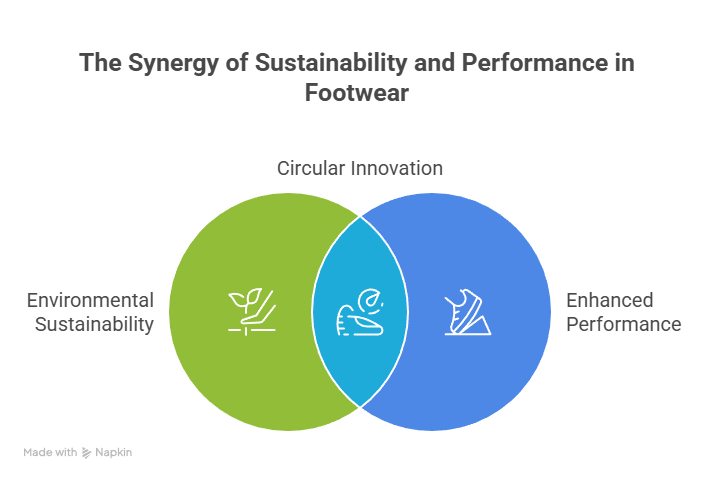
The integration of SCF technology represents a decisive move toward a circular manufacturing model in footwear. It reduces dependence on chemical additives, cuts energy use, and extends the life of materials through recyclability. The GENTREX system enables factories to transition to cleaner production methods. Digital control of temperature, pressure, and gas flow ensures high repeatability and scalability across different material grades and part geometries.
Evaluated across its full life cycle, nitrogen SCF injection provides quantifiable environmental gains: lower greenhouse-gas emissions, reduced chemical hazards, improved energy efficiency, and enhanced recyclability. These outcomes move the footwear industry beyond incremental sustainability efforts and toward fundamental, verifiable change at the process level.
Conclusion
Advancing polymer sustainability in footwear requires technologies that replace reactive chemistries with controlled physical processes. Supercritical fluid injection achieves this by eliminating chemical blowing and crosslinking agents, lowering energy demand, and preserving recyclability at the molecular level. Nitrogen serves as a clean, abundant, and effective medium for this transition. With precisely managed systems such as Tienkang’s GENTREX platform, SCF injection offers an industrially scalable path toward a more sustainable, circular footwear manufacturing ecosystem—one that improves performance while reducing environmental impact.
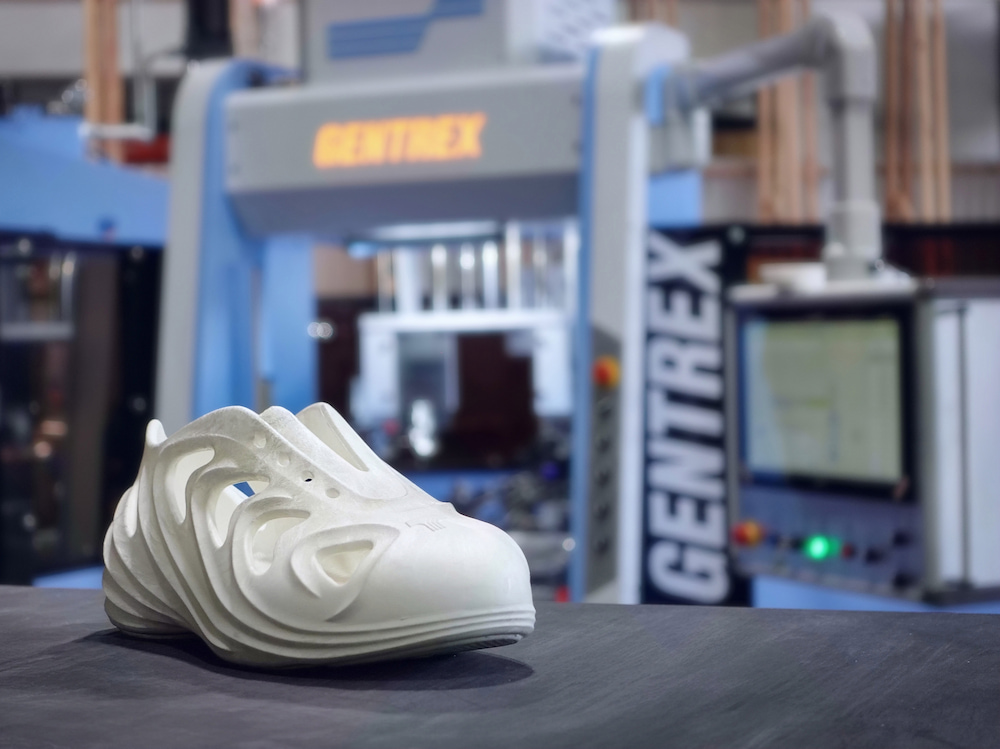
More information: Supercritical fluid injection -GENTREX